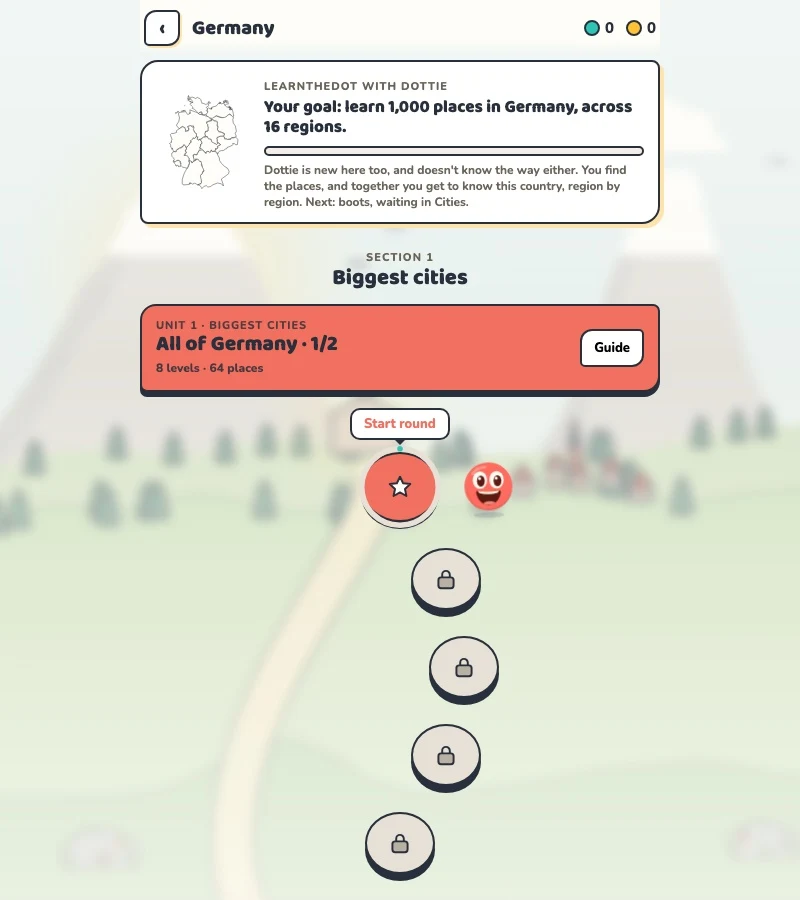
Germany is more than Berlin. Learn the places between.
From Baltic ports to Bavarian towns, build a map of Germany that goes beyond the capital. Find cities, smaller places and familiar landmarks, then discover how they fit together.
The sample needs no account. This guide is in English; game languages vary.
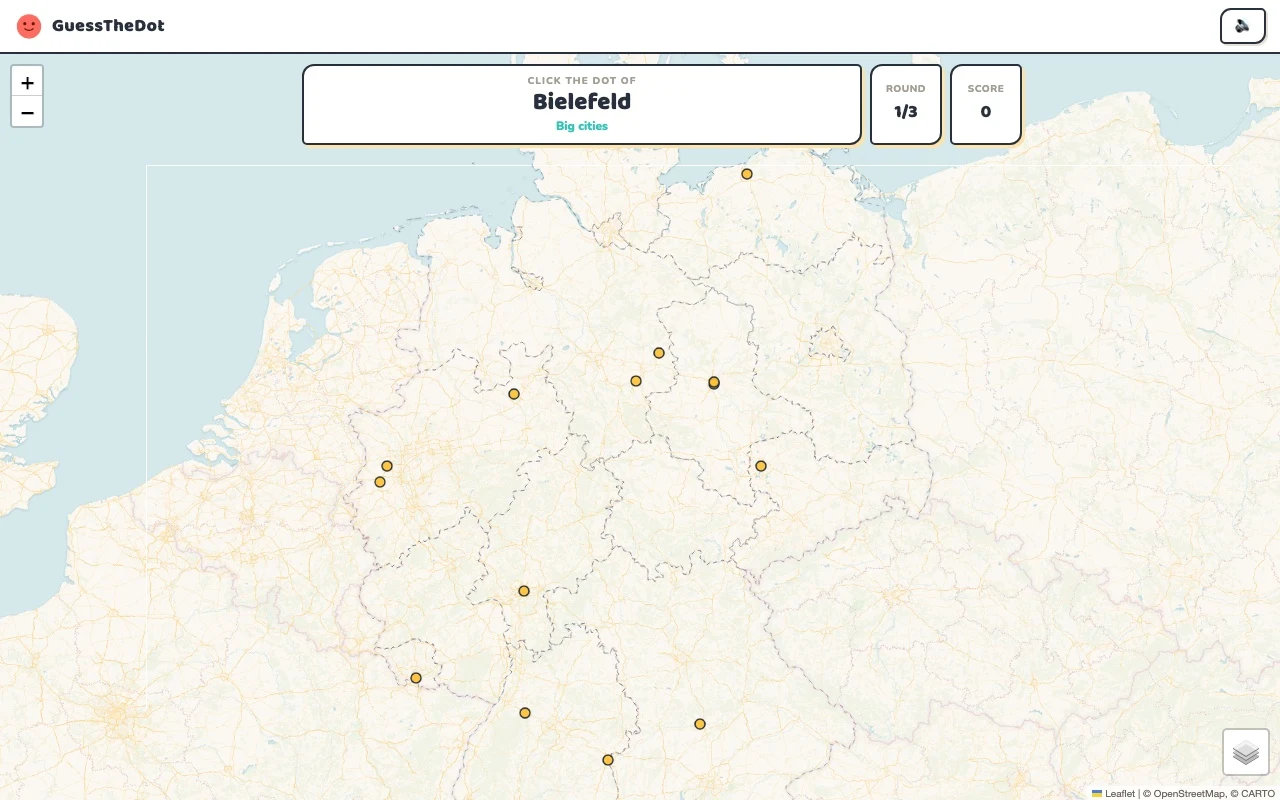
Actual Germany gameplay. No mock-up.
Your learning route
Federal states, river corridors and local towns
Learners building their Bundesländer map; travellers connecting castles and towns.
Short rounds. Immediate feedback.
The practice habit of Duolingo. The map challenge of GeoGuessr.
GuessTheDot brings those two ideas together: short, playful rounds that help you place real cities, villages and landmarks. One name, one map, immediate feedback.
What does each practice format offer?
Feature
GuessTheDotThe combination for geography
DuolingoLanguage lessons
GeoGuessrClassic
Short practice sessions
✓
✓
✓
Immediate answer feedback
✓
✓
✓
Geography map gameplay
✓
—
✓
Practise named cities and villages
✓
—
—
Infer locations from Street View
—
—
✓
Adaptive language lessons
—
✓
—
Free access and extras
Free demo and base game. Account for villages; Pro for extras.
Free language lessons; paid subscriptions for extras.
Limited free version; Pro for broader access.
On a small screen, scroll the table horizontally.
Practise cities and villages on the map.
Want to remember where a city or village is? Practise connecting its name to its location. Choose a country, start with big cities and build a more detailed mental map. GeoGuessr Classic suits discovering locations through street imagery; Duolingo suits practising languages.
About this comparison
The table compares Duolingo language lessons, GeoGuessr Classic and the current GuessTheDot map quiz. Other games or products from these companies are outside its scope. The combination describes the practice format; GuessTheDot does not offer an equivalent adaptive language curriculum or Street View game.
Guess the city. Guess the village. Place the landmark.
Three rounds. The real Germany game.
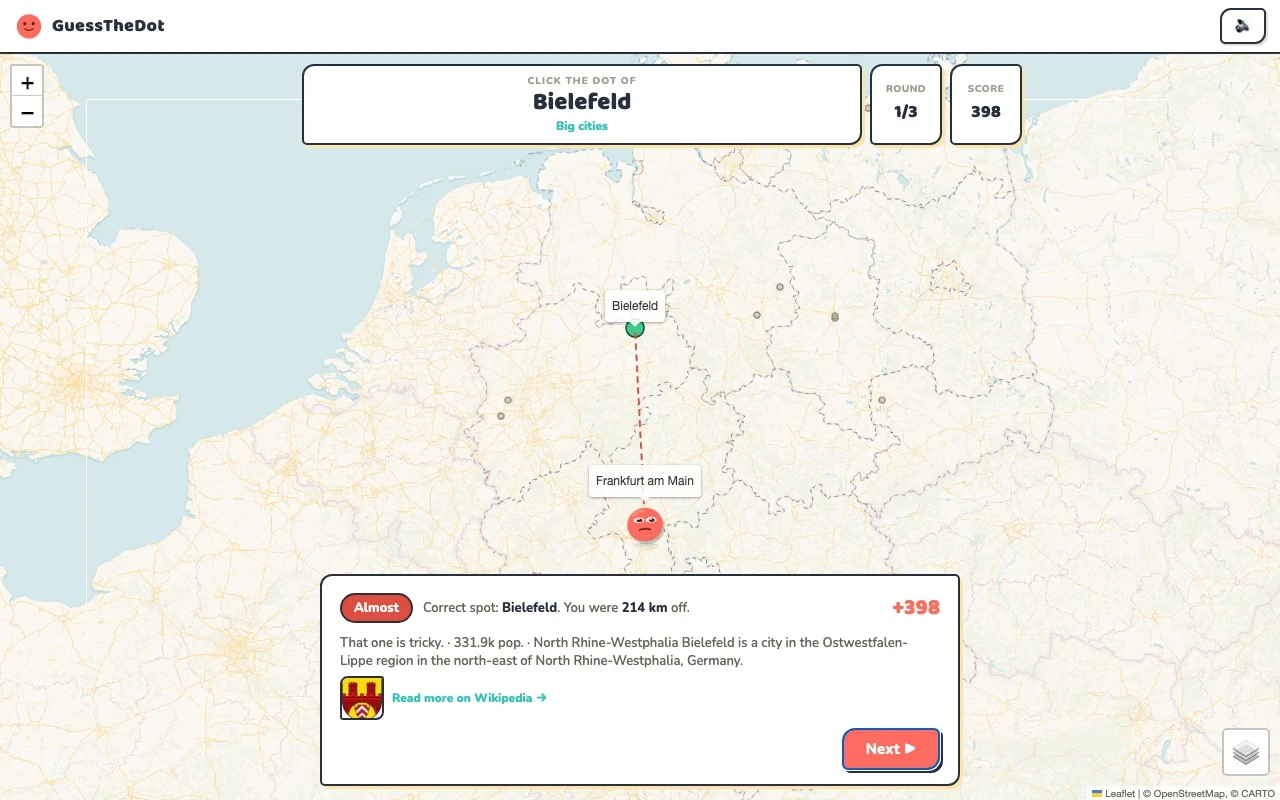
This is the actual GuessTheDot solo game, already set up for three big-city rounds in this country. Choose a map dot, see the real answer feedback and play the next round. Continue in the app when you want a full game.
Three rounds drawn from the country’s big-city dataset. No timer: take your time.
Play the real game3 rounds · no account
The actual map, dots and feedback. Preconfigured for three rounds.
Start with Berlin, Hamburg and München, then connect them to different parts of Germany. A state name is a useful first clue, but it is not the answer: Bayern alone contains many possible places. Compare north and south before you narrow your choice to one dot.
02
Go beyond the big-city shortlist
The interesting challenge begins when the name is Sigmaringen rather than Berlin. Locate a smaller place in relation to a city you already know, then look again without the clue. Our village categories are practical population bands; they do not describe the legal status of a German Stadt or Gemeinde.
03
Turn a landmark into a map anchor
Neuschwanstein is useful as a southern reference point, while the Brandenburg Gate belongs to Berlin. Start with their broad position rather than architectural trivia. In Vacation mode, practise locations of sights within Germany, then zoom into a region or city when you want a tighter challenge.
Existing in-game content
Start with places that anchor the map.
Berlin
Berlin
An eastern anchor, not the centre of every German journey.
52.524°, 13.411°
From the existing place guide
Berlin ist die Hauptstadt und ein Land der Bundesrepublik Deutschland.
Sigmaringen is a town in southern Germany, in the state of Baden-Württemberg. Situated on the upper Danube, it is the capital of the Sigmaringen district.
Find the Bavarian setting behind the familiar image.
47.557°, 10.749°
From the existing place guide
Neuschwanstein Castle (lit. 'Newswanstone') is a 19th-century historicist palace on a rugged hill of the foothills of the Alps in the very south of Germany, near the border with Austria. It is located in the Swabia region of Bavaria, in the municipality of Schwangau, above the incorporated village of Hohenschwangau, which is also the location of Hohenschwangau Castle.
The Brandenburg Gate is an 18th-century neoclassical monument in Berlin, Germany. One of the best-known landmarks of the country, it was erected on the site of a former city gate that marked the start of the road from Berlin to Brandenburg an der Havel, the former capital of the Margraviate of Brandenburg.
Cologne Cathedral is a Catholic cathedral in Cologne, North Rhine-Westphalia, Germany. It is the seat of the Archbishop of Cologne and of the administration of the Archdiocese of Cologne. It is a renowned monument of German Catholicism and Gothic architecture and was declared a World Heritage Site in 1996. It is Germany's most visited landmark, attracting an average of 6 million people a year.
Guide extracts retain their source wording and may use a different language. Wikipedia/Wikivoyage text is available under CC BY-SA; Wikidata factual data is CC0. Individual source links are above.
Real answer feedback from the same country practice session.
Choose your next practice
Make the map more detailed.
The current dataset contains 5,063 place records and 1,413 distinct sightseeing names. These are dataset counts, not a claim to cover every settlement or attraction.