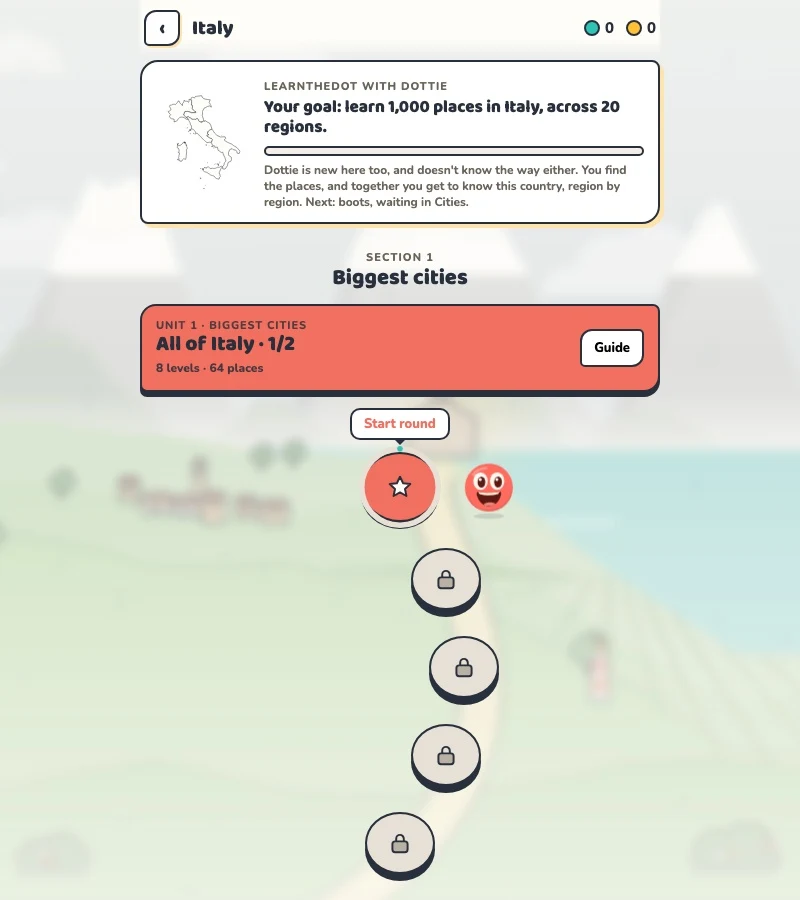
Follow the shape of Italy. Then fill it with places.
Rome is a start, not a finish. Learn how Naples, coastal towns and landmarks sit along the peninsula, with Sicily and Sardinia in their own geographical context.
The sample needs no account. This guide is in English; game languages vary.
Actual Italy gameplay. No mock-up.
Your learning route
Peninsula, regions and islands as separate anchors
Regional map practice, family quizzes and Italian travel preparation.
Short rounds. Immediate feedback.
The practice habit of Duolingo. The map challenge of GeoGuessr.
GuessTheDot brings those two ideas together: short, playful rounds that help you place real cities, villages and landmarks. One name, one map, immediate feedback.
What does each practice format offer?
Feature
GuessTheDotThe combination for geography
DuolingoLanguage lessons
GeoGuessrClassic
Short practice sessions
✓
✓
✓
Immediate answer feedback
✓
✓
✓
Geography map gameplay
✓
—
✓
Practise named cities and villages
✓
—
—
Infer locations from Street View
—
—
✓
Adaptive language lessons
—
✓
—
Free access and extras
Free demo and base game. Account for villages; Pro for extras.
Free language lessons; paid subscriptions for extras.
Limited free version; Pro for broader access.
On a small screen, scroll the table horizontally.
Practise cities and villages on the map.
Want to remember where a city or village is? Practise connecting its name to its location. Choose a country, start with big cities and build a more detailed mental map. GeoGuessr Classic suits discovering locations through street imagery; Duolingo suits practising languages.
About this comparison
The table compares Duolingo language lessons, GeoGuessr Classic and the current GuessTheDot map quiz. Other games or products from these companies are outside its scope. The combination describes the practice format; GuessTheDot does not offer an equivalent adaptive language curriculum or Street View game.
Guess the city. Guess the village. Place the landmark.
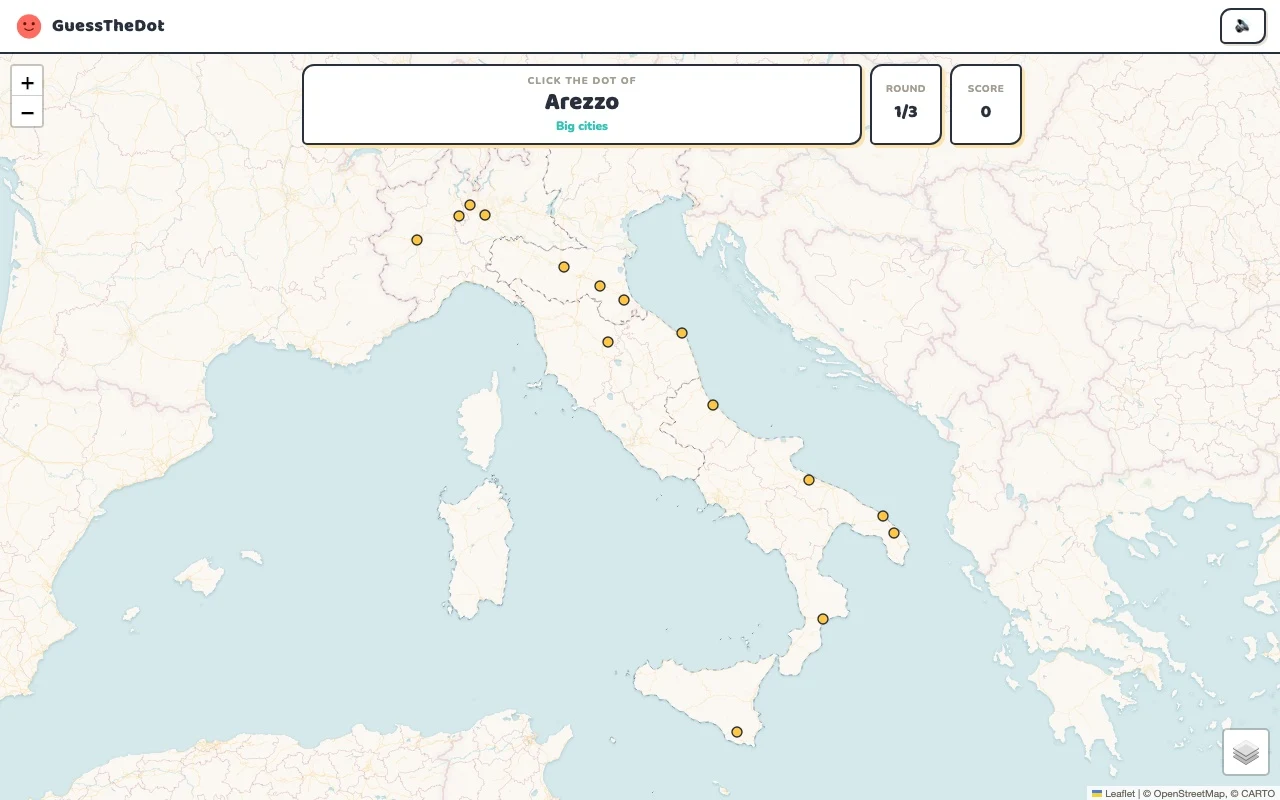
Three rounds. The real Italy game.
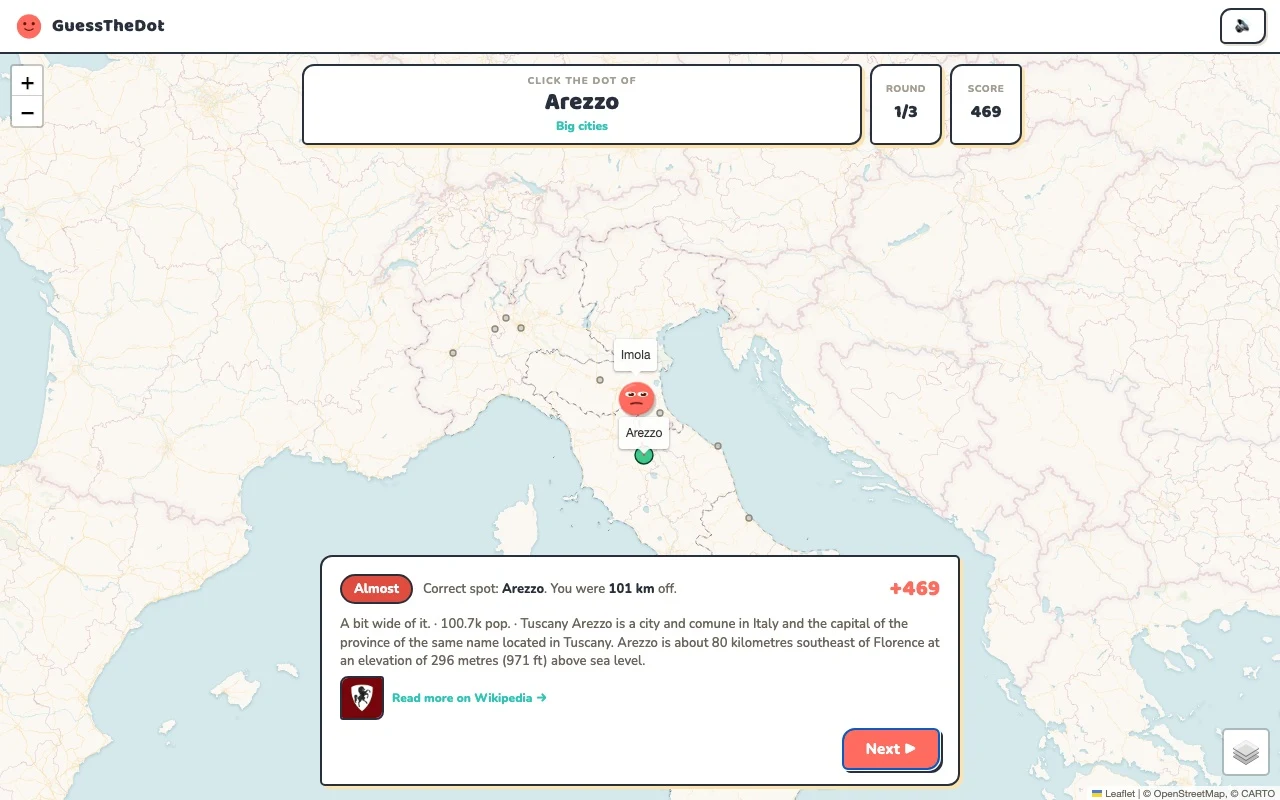
This is the actual GuessTheDot solo game, already set up for three big-city rounds in this country. Choose a map dot, see the real answer feedback and play the next round. Continue in the app when you want a full game.
Three rounds drawn from the country’s big-city dataset. No timer: take your time.
Play the real game3 rounds · no account
The actual map, dots and feedback. Preconfigured for three rounds.
Locate Rome, Naples and Milan broadly before choosing the exact dot. North, centre and south give you a useful first pass, but a city still needs its own position. Alternate a familiar city with a less obvious place so that your map becomes more detailed without turning into a list of isolated names.
02
Connect towns to their region
Vieste is in Apulia; Arenzano is in Liguria. Both are coastal places, but they occupy very different parts of the peninsula. The contrast is the exercise: put the region, coastline and town together. Italian borghi and comuni do not map perfectly to our population categories, so use the list rather than an assumed official definition.
03
Give the islands their own attention
A mainland reference point does not tell you where a place on Sicily or Sardinia belongs. The full game uses the country dataset and its category lists. This sample stays on the peninsula so that a first lesson remains readable; an island-focused itinerary is a separate learning goal rather than a hidden extra question.
Existing in-game content
Start with places that anchor the map.
Lazio
Rome
A central reference for the peninsula.
41.892°, 12.511°
From the existing place guide
Rome is the capital city and most populated comune (municipality) of Italy. It is also the administrative centre of the Lazio region and of the Metropolitan City of Rome.
Vieste è un comune italiano di 13 238 abitanti della provincia di Foggia in Puglia. Rinomata stazione balneare del parco nazionale del Gargano, dal 2023 è riconosciuta bandiera blu.
The Colosseum (KOL-ə-SEE-əm) is an elliptical amphitheatre in the centre of the city of Rome, Italy, just east of the Roman Forum. It is the largest ancient amphitheatre ever built, and is the largest standing amphitheatre in the world. Construction began under the Emperor Vespasian (r. 69–79 AD) in 72 and was completed in AD 80 under his successor and heir, Titus (r.
Locate Pisa rather than only recognising its tower.
43.723°, 10.397°
From the existing place guide
The Leaning Tower of Pisa, or simply the Tower of Pisa (torre di Pisa), is the campanile, or freestanding bell tower, of Pisa Cathedral. It is known for its nearly four-degree lean, the result of an unstable foundation. The tower is one of three structures in Pisa's Cathedral Square (Piazza del Duomo), which includes the cathedral and Pisa Baptistry.
Mount Vesuvius ( və-SOO-vee-əs) is a somma–stratovolcano located on the Gulf of Naples in Campania, Italy, about 9 km (5.6 mi) east of Naples and a short distance from the shore. It is one of several volcanoes forming the Campanian volcanic arc. Vesuvius consists of a large cone partially encircled by the steep rim of a summit caldera, resulting from the collapse of an earlier, much higher structure.
Guide extracts retain their source wording and may use a different language. Wikipedia/Wikivoyage text is available under CC BY-SA; Wikidata factual data is CC0. Individual source links are above.
Real answer feedback from the same country practice session.
Choose your next practice
Make the map more detailed.
The current dataset contains 4,171 place records and 1,682 distinct sightseeing names. These are dataset counts, not a claim to cover every settlement or attraction.