The sample needs no account. This guide is in English; game languages vary.
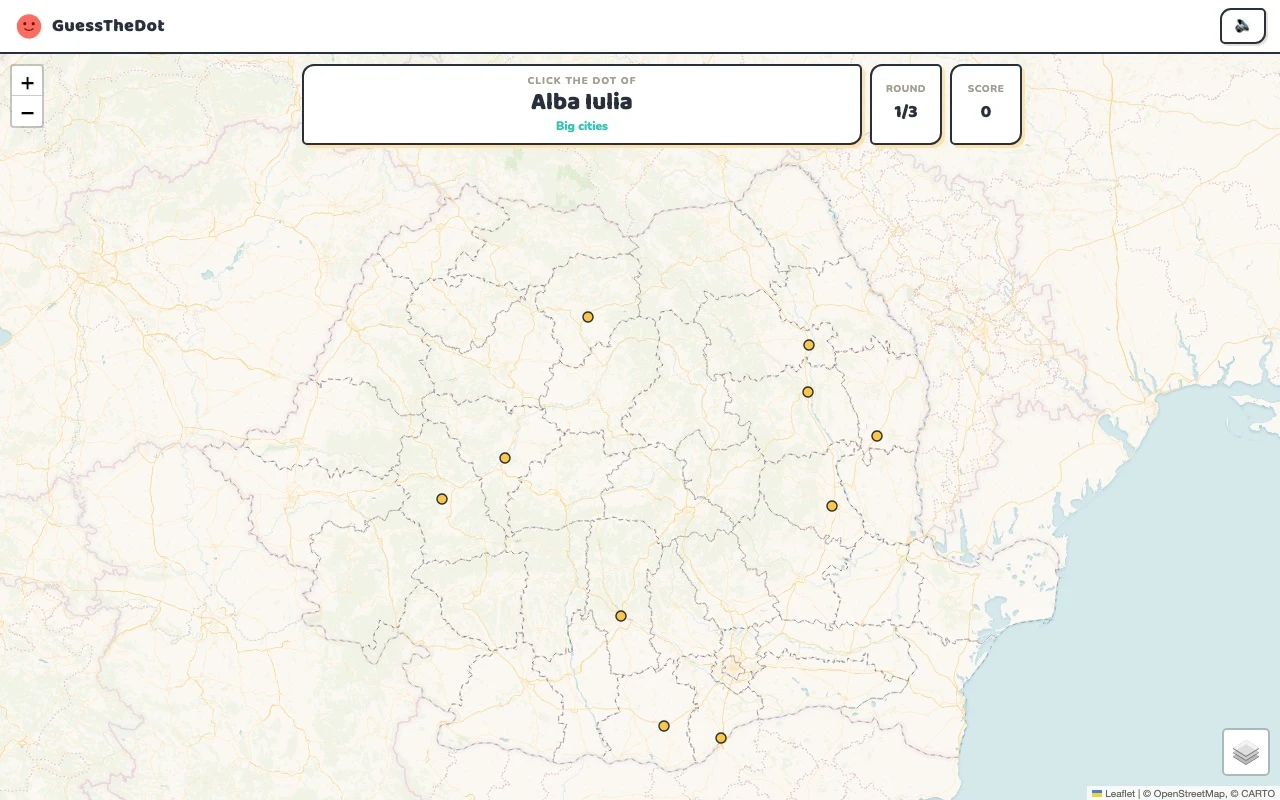
Actual Romania gameplay. No mock-up.
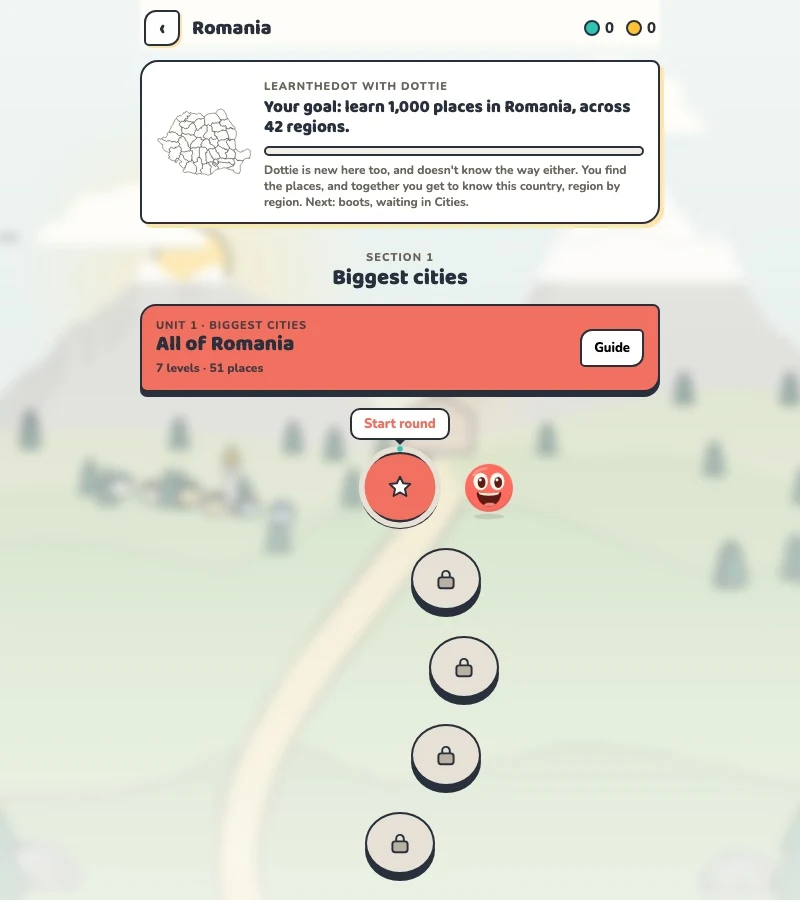
Your learning route
Historic regions versus county labels; Carpathian anchors
Romanian map revision and travellers planning beyond the capital.
Short rounds. Immediate feedback.
The practice habit of Duolingo. The map challenge of GeoGuessr.
GuessTheDot brings those two ideas together: short, playful rounds that help you place real cities, villages and landmarks. One name, one map, immediate feedback.
What does each practice format offer?
Feature
GuessTheDotThe combination for geography
DuolingoLanguage lessons
GeoGuessrClassic
Short practice sessions
✓
✓
✓
Immediate answer feedback
✓
✓
✓
Geography map gameplay
✓
—
✓
Practise named cities and villages
✓
—
—
Infer locations from Street View
—
—
✓
Adaptive language lessons
—
✓
—
Free access and extras
Free demo and base game. Account for villages; Pro for extras.
Free language lessons; paid subscriptions for extras.
Limited free version; Pro for broader access.
On a small screen, scroll the table horizontally.
Practise cities and villages on the map.
Want to remember where a city or village is? Practise connecting its name to its location. Choose a country, start with big cities and build a more detailed mental map. GeoGuessr Classic suits discovering locations through street imagery; Duolingo suits practising languages.
About this comparison
The table compares Duolingo language lessons, GeoGuessr Classic and the current GuessTheDot map quiz. Other games or products from these companies are outside its scope. The combination describes the practice format; GuessTheDot does not offer an equivalent adaptive language curriculum or Street View game.
Guess the city. Guess the village. Place the landmark.
Three rounds. The real Romania game.
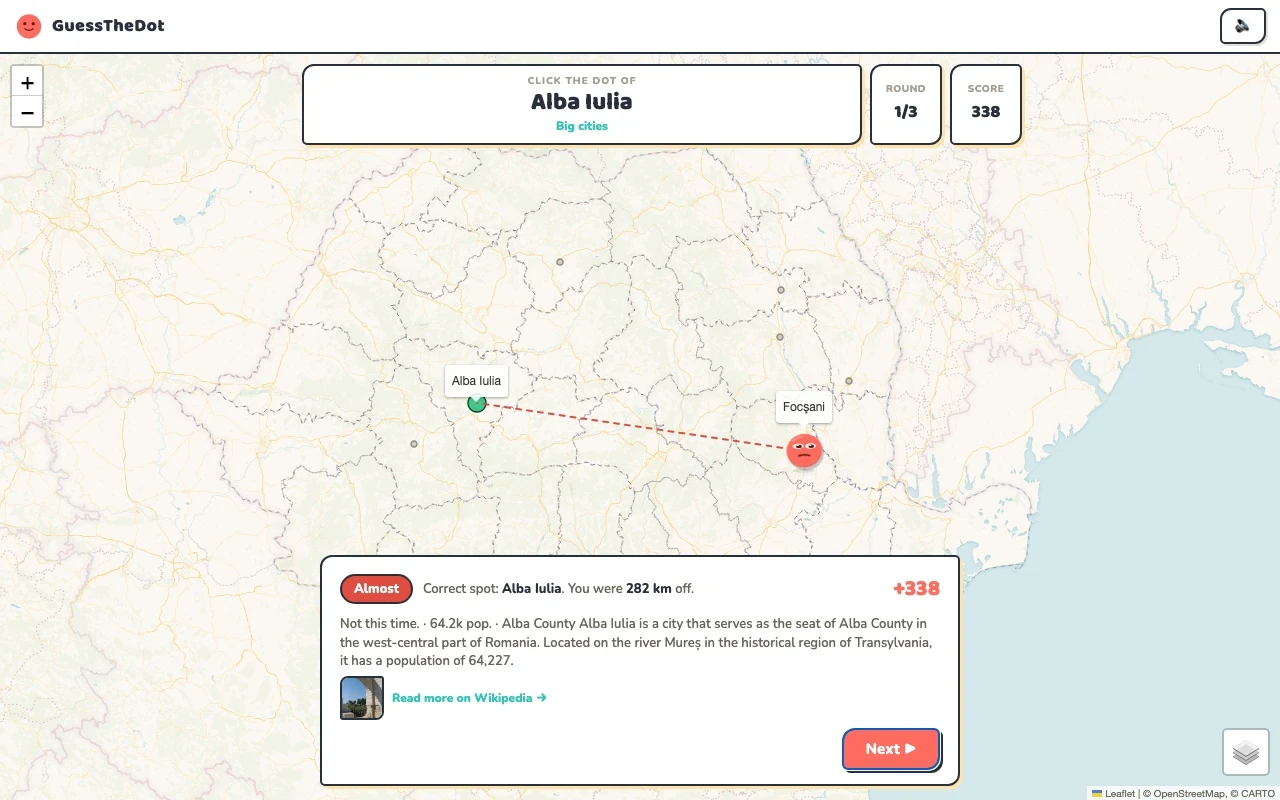
This is the actual GuessTheDot solo game, already set up for three big-city rounds in this country. Choose a map dot, see the real answer feedback and play the next round. Continue in the app when you want a full game.
Three rounds drawn from the country’s big-city dataset. No timer: take your time.
Play the real game3 rounds · no account
The actual map, dots and feedback. Preconfigured for three rounds.
Cluj-Napoca, Braşov and Bucharest are useful but different anchors. A historic name such as Transylvania is not interchangeable with every county label in the game. Start with the supplied county and the place position; use larger cultural regions as context, without expecting one historic label to identify a single dot.
02
Learn the mountain towns between the headlines
Sinaia gives a smaller-scale question near the Carpathian travel corridor. Compare it with a larger city, then locate it again from memory. Our population bands can include places that are locally called towns: the learning goal is to recognise a location, not to rename Romanian settlements.
03
Turn castle recognition into map knowledge
Recognising a photograph of Bran Castle does not show that you can locate it. Put the castle in the Braşov area, then compare its setting with Peleș Castle and the capital’s Palace of the Parliament. The sightseeing mode supplies a reason to explore, while the map asks you to make the spatial connection.
Existing in-game content
Start with places that anchor the map.
Bucharest
Bucharest
Use the capital as a southern reference.
44.432°, 26.106°
From the existing place guide
București este capitala României, cel mai populat oraș și cel mai important centru industrial și comercial al țării.
Bran Castle is a castle in Bran, 25 kilometres (16 mi) southwest of Brașov. The castle was built by Saxons in 1377 who were given the privilege by Louis I of Hungary. It is a national monument and landmark in Transylvania. The fortress is on the Transylvanian side of the historical border with Wallachia, on road DN73. Marketed outside Romania as Dracula's Castle, it is presented as the home of the title character in Bram Stoker's novel Dracula (1897).
Peleș Castle is a Neo-Renaissance palace in the Royal Domain of Sinaia in the Carpathian Mountains, near Sinaia, in Prahova County, Romania, on an existing medieval route linking Transylvania and Wallachia, built between 1873 and 1914. Its inauguration was held in 1883. It was constructed for King Carol I of Romania.
The Palace of the Parliament, initially designed during Communist times as the People's House (Casa Poporului) or (less frequently used) the House of the Republic (Casa Republicii), is the seat of the Parliament of Romania, located atop Dealul Spirii in Bucharest, the national capital.
Guide extracts retain their source wording and may use a different language. Wikipedia/Wikivoyage text is available under CC BY-SA; Wikidata factual data is CC0. Individual source links are above.
Real answer feedback from the same country practice session.
Choose your next practice
Make the map more detailed.
The current dataset contains 2,602 place records and 329 distinct sightseeing names. These are dataset counts, not a claim to cover every settlement or attraction.
Yes. The Romanian city and village lists use the country dataset. This introduction uses a focused set of anchors, while the complete categories go beyond this one region.